
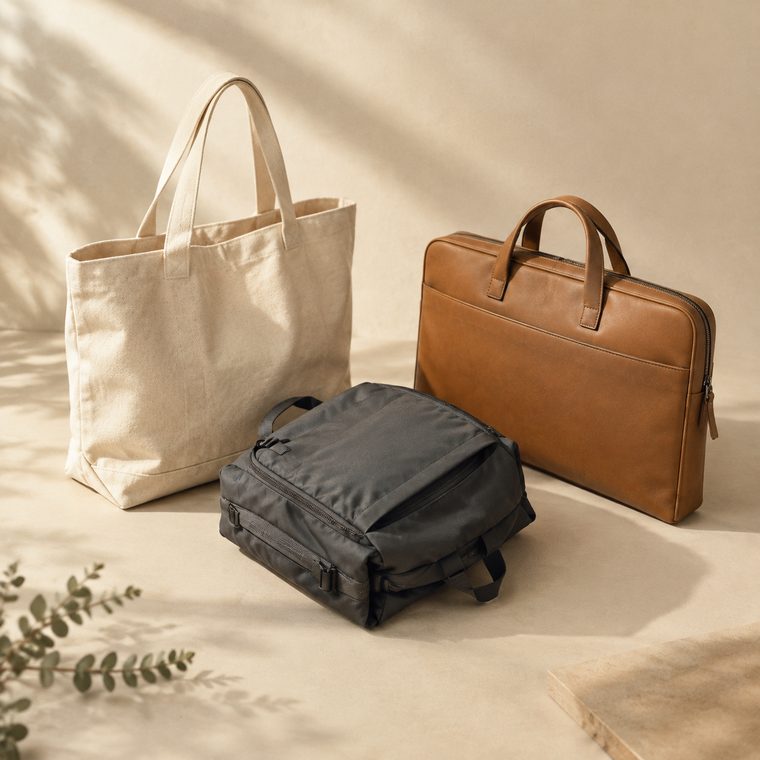
A tote bag looks like the simplest item on a sourcing list. It is fabric, thread and two handles. In practice three decisions set the price before you speak to a factory: which cluster makes it, which fabric it is made from, and how many operations the structure requires. Get those wrong and no amount of negotiation recovers the number.
Where bags are actually made
We read 12,951 company records out of public B2B export listings. The bag and luggage category holds 184 of them, and they are concentrated:
| Province | Bag & luggage records | What the cluster runs on |
|---|---|---|
| Guangdong | 60 | Leather goods, hardware, structure and edging |
| Fujian | 45 | Soft bags, fabric sourcing, high-volume sewing |
| Zhejiang | 33 | Small-batch and short-run work, mixed materials |
| Anhui | 9 | Cost-competitive sewing capacity |
| Jiangsu | 9 | Technical textiles and industrial bags |
Basis: the 184 records in our index classified as bags and luggage, read September 2026. The same category is browsable on the bags and luggage page, and the province totals across all categories are on our province data page.
Two product lines sit inside that category, and they are different businesses wearing the same label:
| Line | Records | Top provinces |
|---|---|---|
| Soft bags & backpacks | 198 | Fujian 62 · Guangdong 56 · Zhejiang 28 |
| Hard-shell luggage | 50 | Fujian 18 · Guangdong 12 · Zhejiang 8 |
Basis: product lines in our index; a record can be matched to more than one line, so line counts do not sum to a category total.
Soft bags are a cutting-and-sewing business. The factory’s real skill is fabric sourcing, pattern accuracy and keeping a seam straight across thousands of units. Hard-shell luggage is a moulding and assembly business, closer to appliance manufacturing than to tailoring. A supplier that is excellent at one is not automatically able to quote the other, and a buyer who sends a soft-bag specification to a luggage moulder will get a polite decline or a subcontract.
The minimum, measured
| Measure | Bags & luggage | All categories in our index |
|---|---|---|
| Records publishing a piece MOQ | 63 | 4,365 |
| Median | 100 | 1 |
| 25th percentile | 2 | 1 |
| 75th percentile | 500 | 100 |
| Under 100 pieces | 38% | 71% |
Basis: records in our index that publish an MOQ beginning with a number and a piece unit, read September 2026. Home storage, for comparison, sits at a median of 50.
Bags carry the highest published minimum of any category we have measured, and the reason is upstream of the factory. Fabric is sold by the roll. A custom colour is a dye lot, and the dye house has its own minimum. Zips, sliders, buckles and D-rings come from component suppliers with minimums that stack. By the time your enquiry reaches a sewing line, the smallest quantity anyone is willing to run has already been decided twice.
The four decisions that set the price
| Decision | What it changes | The trade-off |
|---|---|---|
| Fabric | Denier and weight per square metre; the base cost of the whole bag | A lighter fabric saves money per unit and is the first thing to fail at a loaded seam |
| Hardware | Zip type, sliders, buckles, rings, magnetic closures | Hardware is where a bag fails first and where a supplier substitutes most easily |
| Decoration | Screen print, heat transfer, sublimation, embroidery, patch | Each method has a colour limit and its own minimum; some do not work on every fabric |
| Structure | Panels, lining, internal pockets, piping, base board | Every addition is a station on the line, and stations set the run minimum |
How the decoration method changes the minimum
Decoration is where a tote bag project most often doubles in cost without anyone noticing, because the method gets chosen for the look and priced afterwards.
| Method | What it is good for | What sets its minimum |
|---|---|---|
| Screen print | Bold flat colour on cotton and canvas | One screen per colour, so a four-colour design is four minimums |
| Heat transfer | Full-colour artwork with gradients, on polyester and blends | A transfer per piece, so cost sits per unit rather than per order |
| Sublimation | All-over print that becomes part of the fabric | Light-coloured polyester only – it will not show on dark cotton |
| Embroidery | Logos that have to survive washing and wear | A digitised file and a stitch count for every placement |
| Woven or printed patch | Fine detail and small text | The patch maker’s minimum, which is separate from the bag factory’s |
Two practical consequences. The artwork has to arrive as a vector file – a logo exported from a photograph cannot be screened or embroidered without being redrawn, and the redraw is both a cost and a source of error. And a design using one colour on a stock fabric is a different order from one using four colours on a custom dye, even when the picture on the page looks identical.
What to specify, line by line
- Fabric: type, weight per square metre, and colour – with a note on whether a stock colour is acceptable.
- Dimensions when flat and when loaded, plus the weight the bag must carry.
- Handles or straps: material, length, attachment method, and how it is reinforced.
- Closure: open top, zip, drawstring, flap, magnetic.
- Decoration: method, colours, placement, and the artwork as a vector file.
- Quantity, and whether it is a trial or a forecast.
- Certification needed for the destination market, and for the end user.
Certification is not automatic in this category
Only 45% of the bag and luggage records in our index name any certification at all – the lowest share of the categories we have looked at. Across the whole index, EN71 appears on 118 records and CPC on 37, so a supplier who can produce a general certificate is not automatically able to produce the toy-safety or children’s-product document.
Two cases are worth planning for before the artwork is drawn. A backpack or a pencil case sold for children is a children’s product in most markets, with its own testing regime. And a recycled-fabric claim needs traceability through the supply chain rather than a label on a swatch: GRS appears on 119 records in our index, and when it does, the question is which certificate covers your order and who issued it.
Two lines to add to the order
Write the hardware specification into the purchase order by name, and write the fabric weight in grams per square metre. Those two lines are what an inspection can measure and what a substitution violates. Everything else in a bag order is negotiable at the margin; those two are the product.
Where tote bag orders go wrong
- Colour that moves. A screen print on a dark fabric, or a dye lot that shifts between the sample and the bulk, is the most common complaint in this category. Ask for a colour-fastness statement and a production sample from the bulk run.
- Hardware substitution. The zip on the sample is not always the zip on the order. Write the hardware specification into the order, including the brand or the standard if you have one, and check it at inspection.
- A recycled claim without the document. The claim is easy to print and expensive to defend. If it is going on the product, get the certificate first.
What to ask for at the sampling stage
Three things beyond the sample itself. A price for the same specification at three quantities, so you can see what the fabric minimum is doing to the unit cost. A list of the operations in your design, so you can see which ones are worth paying for. And a production sample pulled from the bulk fabric rather than a swatch cut for you, because a swatch is chosen and a bulk roll is not.
Then compare two suppliers on the same written specification rather than on two photographs. Whether the seller owns the sewing line or places the order with one is a separate question, and it is worth understanding before you sign – it is set out in trading company or factory. What the inspection measures against is on quality control.
Send the construction, the fabric, the print and the quantity. You will get the unit price at each quantity and the minimum that applies to that specification, rather than the one printed on a listing.